Challenge of treatments for persistent disease
A challenge for vaccines and immunotherapy is to protect against recurring persistent disease. Solving this problem requires new approaches to modulating immunity. Virothera has created new solutions inspired by novel virus mechanisms. We use nucleic acid technology, DNA or RNA, for gene therapy for immunotherapy.
To meet this challenge, we have novel immunotherapeutics for gene-based delivery based on a human homologue of a virus gene, a virokine. Our virokine genes encode novel chemokines, 'chemo-attractant cytokines', that can bind or signal to specific chemokine receptors. Chemokines can direct recruitment of immune cells by binding then signaling to chemokine receptors present on different immune cell subsets, for example T lymphocytes, effectors or regulators of cellular immunity, attracting them to sites of cell damage where the chemokines are secreted.
Proprietary biotechnology
Our proprietary, 'virokine immune therapeutic', VIT, retains binding but not signaling function, thereby inhibiting chemokine receptors. The specificity includes chemokine receptors on T regulatory immune cells, T-reg. The VIT can inhibit by binding these chemokine receptors, giving an immunostimulatory effect for vaccines. Conversely, our human 'cytokine immune regulator', CIR, can bind and signal to these regulatory receptors, giving an inhibitory effect for treatment of dysregulated immunity, such as autoimmune conditions. We tested our novel therapeutics combined with our proprietary antigen delivery technology, 'virus like membranes', VLM, expressing multiple genes of the virus entry complex stabilised in membranes.
Our proprietary technologies allow gene expression in vivo modulating immunity using virus inspired mechanisms without the need of a virus vector.
Technology for HSV-2
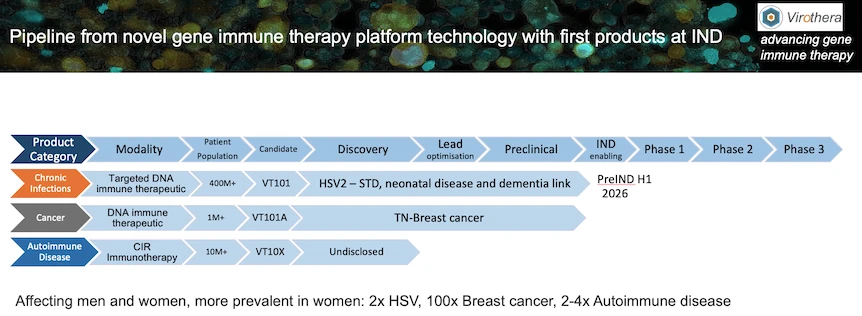
We show, via NIH/NIAID programs, preclinical proof of concept in an in vivo animal model under further IND enabling studies. Immunisation with HSV-2 VLM DNA gave 100% protection against acute HSV-2 disease and 70-100% protection as a therapeutic in those already infected.
Immunising both VLM and VIT technologies provided complete protection for most animals against virus recurrence and reduced reactivated virus secretion, advancing from previous clinically trialled vaccines.
HSV-2 is one of the world’s major STD, causing neonatal mortality, increased HIV transmission, and a raised risk for women. Severe HSV causes neurological disease and there is a link with dementia. The virus goes latent for life and can reactivate to cause recurrent disease. Treatment is required for a healthy lifespan and there is currently no vaccine or cure (WHO).
Find out more
Technology for oncology and autoimmunity
Previously antibodies inhibiting specific chemokines or their receptors have shown promise in therapy for treating select cancers as well as autoimmune disease. Our gene-based technologies could progress these approaches through new pathways.
Breast cancer has recently overtaken lung cancer, as the highest world incidence (WHO). It has poor prognosis with activation of certain chemokine receptors, such as CCR5, which our technology could treat. Triple negative breast cancer is highly aggressive, affects younger women and has poor prognosis with few treatment options.
Application of our technologies show potential in preclinical models for novel breakthrough gene immunotherapeutic treatments for these difficult to treat persistent pathologies.
Intellectual property
Virothera filed patents for VLM, VIT and CIR technologies for DNA, RNA or protein with patent grants for VIT.
Pipeline
HSV-2 and breast cancer require new interventions not only for women’s health, but for healthy families worldwide.